When Indian businesses decide to invest in digital advertising, one question usually comes first:
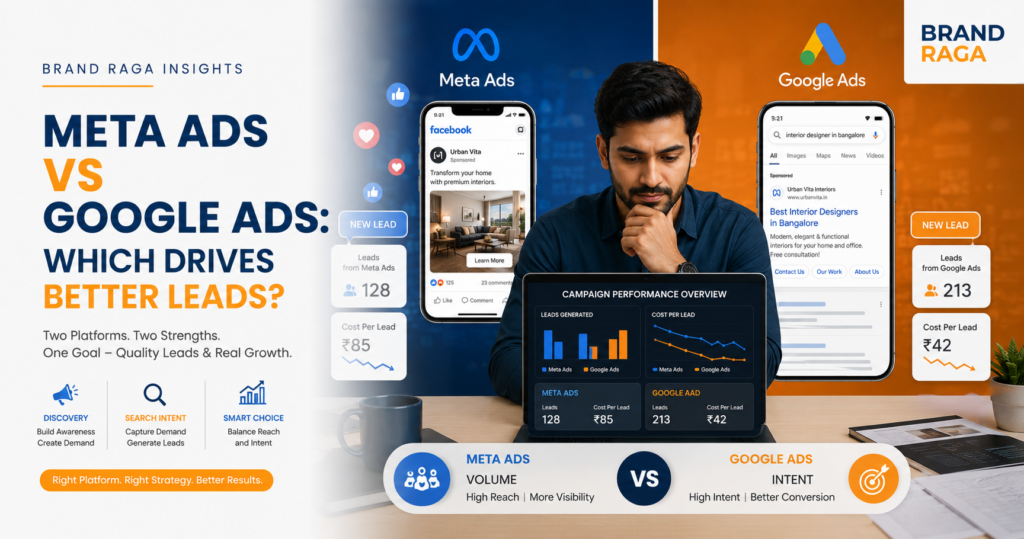
Meta Ads vs Google Ads—which platform generates better leads?
There is no single answer that works for every business.
Google Ads and Meta Ads reach customers at different stages of their buying journey. Google Ads usually captures people who are already searching for a product, service or solution. Meta Ads introduces businesses to potential customers while they are browsing Facebook and Instagram.
The right advertising platform depends on several factors, including:
Your industry
Customer behaviour
Target location
Product or service value
Advertising budget
Sales process
Campaign objective
Existing market demand
For many Indian businesses, the real question is not whether Meta Ads or Google Ads is universally better. The better question is:
Which platform matches the way my customers discover, evaluate and purchase my product or service?
In this guide, we compare Meta Ads and Google Ads based on lead quality, cost per lead, targeting options, user intent, advertising budget and suitability for different industries.
Meta Ads vs Google Ads: Quick Answer
Choose Google Ads when customers are already searching for your product or service and you want to capture high-intent enquiries.
Choose Meta Ads when you want to create awareness, reach a larger audience, launch a new product or generate demand through visual content.
Use both platforms together when you want to build a complete lead-generation funnel.
Meta Ads can introduce your brand and create interest. Google Ads can capture potential customers when they begin actively searching for your product, service or business.
The best platform is not always the one that generates the cheapest leads. It is the platform that produces the most qualified leads and customers at a profitable acquisition cost.
How Do Google Ads Work?
Google Ads allows businesses to display advertisements when people search for relevant products, services or information.
For example, a potential customer may search for:
2 BHK flats in Mysuru
Skin clinic near me
Digital marketing agency in Bangalore
CA for GST filing
Best CBSE school in Hubli
Commercial property in Whitefield
Interior designers near me
A relevant advertisement can appear at the top or bottom of the Google search results.
Google Search Ads are therefore considered intent-based advertising. The potential customer has already identified a need and is actively searching for a solution.
Common Google Ads Formats
Google advertising formats include:
Search Ads
Display Ads
Shopping Ads
YouTube Ads
Demand Generation campaigns
App campaigns
Performance Max campaigns
For lead generation, Search Ads are often the best starting point because businesses can target keywords related to their products and services.
However, selecting the right keywords is only one part of a successful campaign. Performance also depends on the advertisement, landing page, location targeting, conversion tracking, offer and sales follow-up process.
How Do Meta Ads Work?
Meta Ads appear across Facebook and Instagram.
Unlike Google Search Ads, Meta Ads do not mainly depend on someone searching for a keyword. Instead, businesses can reach potential customers based on factors such as:
Location
Age
Interests
Online behaviour
Previous engagement
Website visits
Customer lists
Similar audiences
This makes Meta Ads a discovery and demand-generation platform.
A user may not be searching for a new apartment, skincare treatment, restaurant, coaching institute or clothing brand. However, an attractive advertisement can capture attention, create interest and encourage the user to enquire.
Common Meta Ads Formats
Meta advertising formats include:
Image advertisements
Video advertisements
Instagram Reels advertisements
Stories advertisements
Carousel advertisements
Instant form lead advertisements
Website conversion advertisements
Click-to-WhatsApp advertisements
Messenger advertisements
Call advertisements
Meta Ads are particularly useful for:
Building brand awareness
Introducing new products
Promoting visually attractive offers
Reaching local audiences
Retargeting interested users
Generating demand where search volume is limited
Meta Ads vs Google Ads: Comparison
Factor |
Google Ads |
Meta Ads |
|---|---|---|
| User behaviour | Users are actively searching | Users are browsing social media |
| User intent | Usually high | Usually low to medium initially |
| Lead quality | Often stronger because of search intent | Can vary depending on campaign setup |
| Cost per lead | Often higher in competitive sectors | Frequently lower, but quality may vary |
| Targeting | Keywords, searches, location, device and audiences | Interests, demographics, behaviour and engagement |
| Best purpose | Capturing existing demand | Creating awareness and demand |
| Creative requirement | Strong copy and landing page | Strong images, videos, hooks and offers |
| Retargeting | Available across Google platforms | Available across Facebook and Instagram |
| Suitable industries | Real estate, healthcare, education, legal and B2B | D2C, fashion, beauty, food, events and lifestyle |
Both platforms can generate high-quality leads when the campaign is built around the customer journey.
Which Platform Generates Better-Quality Leads?
Google Ads often generates stronger-intent leads because the customer initiates the search.
For example, someone searching for “Orthopaedic doctor in Bangalore” is likely to have a specific requirement. Someone searching for “warehouse for rent near Peenya” may already be comparing commercial properties.
However, this does not mean every Google Ads lead will be qualified.
Businesses may still receive:
Job enquiries
Vendor calls
Students looking for free information
Irrelevant service requests
Enquiries from outside the target area
Competitor clicks
Negative keywords, accurate location settings, relevant advertisement copy and a qualifying landing page are essential.
Meta Ads can generate higher lead volumes at a lower initial cost. However, users may be at an earlier stage of the buying journey.
Some people may submit a form because the advertisement looked interesting, even if they are not ready to purchase immediately.
Meta lead quality depends on:
Audience selection
Creative quality
Offer
Lead-form questions
Landing-page experience
Sales follow-up
Retargeting strategy
This is why businesses should not compare Meta Ads and Google Ads using cost per lead alone.
Cost Per Lead vs Cost Per Qualified Lead
One of the biggest paid advertising mistakes is focusing only on cost per lead, commonly called CPL.
Consider the following example.
Campaign A
Total advertising cost: ₹30,000
Leads generated: 100
Cost per lead: ₹300
Qualified leads: 10
Cost per qualified lead: ₹3,000
Campaign B
Total advertising cost: ₹24,000
Leads generated: 40
Cost per lead: ₹600
Qualified leads: 16
Cost per qualified lead: ₹1,500
Campaign A looks cheaper when judged only by cost per lead.
However, Campaign B is more effective because it generates more qualified enquiries at a lower cost per qualified lead.
Businesses should track:
Cost per lead
Cost per qualified lead
Lead-to-appointment rate
Lead-to-site-visit rate
Lead-to-sale rate
Customer acquisition cost
Revenue generated
Return on advertising spend
A cheap lead that never answers a call is not necessarily better than a more expensive lead that becomes a customer.
When Should You Choose Google Ads?
Google Ads may be the better choice when customers are already searching for the product or service you offer.
Choose Google Ads when:
Your service has existing search demand
Customers need an immediate solution
You want enquiries from people with stronger intent
Your product has a clearly defined category
Your business operates in a specific location
You have a conversion-focused landing page
You can track calls, forms, bookings or purchases
Businesses That Can Benefit from Google Ads
Google Ads can work effectively for:
Real estate developers
Hospitals and clinics
Lawyers and legal consultants
Chartered accountants
Educational institutions
Home-service providers
Repair and maintenance businesses
B2B service companies
Hotels and travel businesses
Software companies
Google Ads Example for Real Estate
Consider a real estate developer promoting apartments in Mysuru.
The developer may target searches such as:
2 BHK flats in Mysuru
Apartments near Ring Road Mysuru
Flats in Mysuru under ₹50 lakh
RERA-approved projects in Mysuru
New apartments for sale in Mysuru
These searches show that the user is already researching property options.
The cost per enquiry may be higher than a broad Meta Ads campaign. However, the user may be more likely to request a brochure, schedule a site visit or speak with a sales representative.
When Should You Choose Meta Ads?
Meta Ads may be the better choice when customers are not actively searching for your product or when visual communication can create interest.
Choose Meta Ads when:
You are launching a new product or service
Your category has limited search volume
You want to build awareness in a particular location
Your product benefits from strong images or videos
You want to reach a large audience
You want to retarget previous visitors
Your offer requires explanation or demonstration
You want to generate enquiries through Instagram and Facebook
Businesses That Can Benefit from Meta Ads
Meta Ads can work well for:
D2C brands
Fashion and jewellery businesses
Beauty and skincare clinics
Restaurants and cafés
Gyms and fitness centres
Events and exhibitions
Interior designers
Wedding-related businesses
Schools and coaching institutes
Local retailers
Real estate awareness campaigns
Meta Ads Example for a D2C Brand
Consider a healthy snack brand targeting young professionals in HSR Layout, Indiranagar and Koramangala.
Potential customers may not actively search for healthy snack brands every day. However, an attractive Instagram Reel showing the product, ingredients, benefits and introductory offer can create demand.
Meta Ads can help the brand:
Introduce the product
Build recognition
Generate website visits
Promote an introductory offer
Retarget people who watched the video
Encourage first-time purchases
In this case, Meta Ads may be more effective than depending only on existing Google search demand.
Can You Run Meta Ads and Google Ads Together?
Yes.
For many Indian businesses, using both platforms creates a stronger marketing funnel.
A combined strategy may look like this:
Stage 1: Build Awareness with Meta Ads
Use Facebook and Instagram advertisements to introduce the brand, explain the offer and reach relevant audiences.
Stage 2: Capture Demand with Google Ads
When interested users search for the business, product or service category, Google Ads can help the brand remain visible.
Stage 3: Retarget Interested Users
Use Meta and Google retargeting campaigns to reconnect with people who:
Visited your website
Viewed important service pages
Watched your videos
Engaged with your social media page
Opened a lead form
Started but did not complete an enquiry
Added products to their cart
Example for an Educational Institution
A coaching institute in Bangalore may use Meta Ads to build awareness among students and parents.
At the same time, it can run Google Ads for searches such as:
IIT JEE coaching in Bangalore
NEET coaching near me
Best PU college with CET coaching
JEE crash course Bangalore
Meta Ads create awareness, while Google Ads capture students who are actively comparing institutes.
Meta Instant Forms vs Website Landing Pages
Meta Instant Forms allow users to submit their contact information without leaving Facebook or Instagram.
These forms can generate a high volume of leads because the process is quick and convenient. However, this convenience may also attract casual or low-intent enquiries.
A website landing page requires the user to click the advertisement, read the offer and complete a separate form.
This additional step can reduce the overall lead volume, but it may improve lead quality when the landing page is properly designed.
Use Meta Instant Forms When:
You need a simple enquiry
Your audience is mobile-first
Your website is not conversion-ready
You have a strong telecalling team
Lead volume is a priority
Your sales team can follow up quickly
Use a Website Landing Page When:
Your product is expensive or complex
Your offer requires detailed explanation
You need to qualify users before submission
You want stronger website analytics
Your team receives too many irrelevant leads
You need to track user behaviour
Businesses should test both options and compare the number of qualified enquiries rather than only the total form submissions.
How Much Should Indian Businesses Spend?
There is no universal advertising budget that works for every business.
A small business can begin with ₹10,000–₹15,000 per month. However, a very limited budget may not generate enough data to test multiple audiences, keywords, advertisements and landing pages.
Practical Monthly Testing Budgets
Meta Ads: ₹10,000–₹30,000 or more
Google Ads: ₹20,000–₹50,000 or more
Combined Meta and Google Ads strategy: ₹40,000–₹1,00,000 or more
These figures are approximate testing ranges and not guaranteed performance levels.
The required budget depends on:
Industry competition
Target city
Size of the target audience
Average product or service value
Customer lifetime value
Sales conversion rate
Keyword search volume
Required lead volume
Number of campaign objectives
A business selling a ₹500 product and a real estate company selling a ₹75 lakh apartment should not use the same advertising benchmarks.
How Long Does It Take to Generate Leads?
Google Ads can begin generating clicks and enquiries soon after a campaign is activated, provided there is enough search demand.
However, the first few leads may not provide enough information to judge long-term campaign performance.
Meta campaigns may require time and conversion data before performance stabilizes.
During the initial campaign period:
Confirm that conversion tracking is working
Check whether the leads are relevant
Avoid making unnecessary daily changes
Monitor audience and keyword performance
Evaluate qualified leads instead of only total leads
Correct tracking, location or targeting errors immediately
Businesses should not judge a campaign after only one or two days. At the same time, they should not continue a clearly broken campaign simply because it needs more time.
How to Reduce Cost Per Lead on Google Ads
Businesses can improve Google Ads performance by following these practices.
Target High-Intent Keywords
Prioritize searches that indicate purchase or enquiry intent instead of targeting only broad informational keywords.
For example, “2 BHK apartment for sale in Hubli” may have stronger commercial intent than “types of apartments.”
Use Negative Keywords
Exclude searches related to:
Jobs
Free services
Training
Definitions
Unrelated locations
Irrelevant products
Competitor services that you do not offer
Improve Advertisement Relevance
Ensure that the keyword, advertisement and landing-page message are closely connected.
A person searching for a specific service should reach a page focused on that service.
Create Dedicated Landing Pages
Avoid sending every advertising campaign to the website homepage.
Use a focused landing page with:
A clear headline
Key benefits
Supporting proof
Relevant images
Contact details
One clear call to action
Improve the Mobile Experience
Forms, buttons, page content and contact options should work properly on mobile devices.
A slow or poorly designed mobile page can reduce conversions even when the advertisement performs well.
Track Meaningful Conversions
Track completed forms, qualified calls, appointments, site visits and sales instead of counting only website visits.
Review Search Terms Regularly
Identify irrelevant searches and find new keyword opportunities.
Regular search-term reviews can help reduce wasted spending and improve lead quality.
How to Reduce Cost Per Lead on Meta Ads
Businesses can improve Meta Ads performance through the following steps.
Test Different Creative Angles
Test different advertising messages, including:
Customer problems
Product benefits
Demonstrations
Testimonials
Offers
Educational content
Before-and-after outcomes where permitted
Location benefits
Use Multiple Formats
Compare:
Static images
Carousel advertisements
Short videos
Stories
Reels
Customer testimonials
Product demonstrations
Do not assume that one advertisement format will always generate the best results.
Strengthen the Opening Hook
The first few seconds of a video or the first visible line should clearly explain why the user should pay attention.
A strong hook should immediately communicate the customer problem, benefit or offer.
Add Qualifying Questions
Ask about relevant factors such as:
Budget
Location
Requirement
Service type
Purchase timeline
Preferred appointment date
Qualifying questions can reduce casual submissions.
Improve the Offer
A weak or unclear offer cannot be fixed through targeting alone.
Clearly explain:
What the customer receives
Why the offer is valuable
Who the offer is suitable for
What action the customer should take
Retarget Engaged Audiences
Run campaigns for:
Website visitors
Video viewers
Instagram engagers
Facebook page engagers
Users who opened previous lead forms
People who added products to their cart
Previous customer lists where appropriate
Improve Sales Follow-Up
Contact new leads quickly and maintain a structured follow-up process.
The campaign may generate a good enquiry, but poor follow-up can still result in a lost sale.
Common Paid Advertising Mistakes
Choosing a Platform Only Because the CPL Is Lower
A ₹200 lead that does not answer the phone can be less valuable than a ₹1,000 lead that converts into a customer.
Sending Traffic to the Homepage
A homepage usually contains several messages and options.
A campaign-specific landing page should focus on one offer and one action.
Using One Meta Creative for Too Long
Users may stop responding after repeatedly seeing the same creative.
Introduce new hooks, formats and messages regularly.
Ignoring Negative Keywords
Irrelevant searches can consume a significant portion of the Google Ads budget.
Targeting an Entire State Without a Clear Reason
A local clinic, school or property project should not target every user in Karnataka unless the business genuinely serves the entire state.
Tracking Leads Without Tracking Sales
Advertising reports should connect campaign data with:
Calls
Meetings
Appointments
Site visits
Purchases
Bookings
Revenue
Making Frequent Campaign Changes
Repeatedly changing budgets, audiences, creatives and optimization settings can make campaign performance difficult to evaluate.
Treating Every Business the Same
A strategy that works for a restaurant may not work for a real estate developer, hospital, coaching institute or B2B software company.
Which Advertising Metrics Should You Track?
A proper lead-generation report should include:
Advertising spend
Impressions
Reach
Click-through rate
Cost per click
Landing-page views
Leads generated
Cost per lead
Qualified leads
Cost per qualified lead
Appointments or site visits
Sales generated
Customer acquisition cost
Revenue attributed to advertising
Return on advertising spend
For service businesses, cost per qualified lead and cost per customer are generally more useful than cost per lead alone.
Metrics for Real Estate Businesses
Real estate companies should track:
Valid enquiries
Brochure downloads
Sales calls
Site visits
Follow-up status
Bookings
Metrics for Clinics
Clinics should track:
Appointment enquiries
Confirmed appointments
Completed consultations
Treatment enquiries
Treatment revenue
Metrics for Educational Institutions
Educational institutions should track:
Counselling enquiries
Campus visits
Applications
Admission confirmations
Meta Ads vs Google Ads by Industry
Real Estate
Use Google Ads to capture active property searches.
Use Meta Ads for:
Project awareness
Walkthrough videos
Amenities
Location benefits
Offers
Retargeting
Recommended approach: Use both platforms.
Healthcare and Clinics
Use Google Ads for treatment-related and local searches.
Use Meta Ads for awareness, educational content and retargeting while following applicable advertising policies.
Recommended approach: Google-led strategy supported by Meta Ads.
D2C and Ecommerce
Use Meta Ads for:
Product discovery
Creative testing
Offer promotion
Retargeting
Use Google Ads to capture product-related searches and shopping intent.
Recommended approach: Use both platforms.
Education
Use Google Ads for course-related searches and Meta Ads for awareness among students and parents.
Recommended approach: Use both platforms.
Legal and Emergency Services
Customers usually search when they need immediate assistance.
Recommended approach: Google Ads.
Restaurants, Events and Lifestyle Brands
Visual content, local targeting and attractive offers can generate awareness and visits.
Recommended approach: Meta-led strategy with Google support.
B2B Services
Google Ads can capture solution-related searches, while Meta Ads can support awareness and retargeting.
Recommended approach: Google-led strategy.
Final Verdict: Meta Ads or Google Ads?
Google Ads generally performs better when:
Customers are already searching
The requirement is immediate
Search intent is strong
Lead quality is more important than maximum volume
Meta Ads generally performs better when:
The business needs awareness
Customers are not actively searching
Visual communication influences decisions
The goal is to reach and educate a larger audience
Retargeting is important
For many Indian businesses, the best strategy is not Meta Ads versus Google Ads.
It is Meta Ads and Google Ads working together.
Meta Ads can create awareness and generate demand. Google Ads can capture that demand when users begin searching.
Retargeting can keep the business visible until the customer is ready to enquire or purchase.
The final decision should be based on:
Qualified leads
Customer acquisition cost
Sales generated
Revenue
Return on advertising spend
It should not be based only on platform preference, total lead volume or the cheapest cost per lead.
How Brand Raga Approaches Performance Marketing
Brand Raga manages performance marketing campaigns across Google Ads, Meta Ads and YouTube for businesses in industries such as real estate, education, healthcare, retail and events.
Our focus is not simply on generating a high number of form submissions.
Campaigns are planned around:
Lead quality
Audience intent
Landing-page experience
Conversion tracking
Cost per qualified lead
Sales outcomes
Continuous campaign optimization
With more than 15,000 leads generated across campaigns, Brand Raga helps businesses move beyond basic campaign setup and focus on measurable business results.
Explore our Performance Marketing Services to understand how we plan, manage and optimize lead-generation campaigns.
Need help deciding between Meta Ads and Google Ads for your business?
Talk to Brand Raga for a strategy based on your industry, location, audience, budget and lead-generation goals.
Phone: +91 98444 35492
Email: mail@brandraga.com
Website: brandraga.com
Frequently Asked Questions
Which Platform Has a Lower Cost Per Lead in India?
Meta Ads often generate leads at a lower initial cost, especially for B2C products and visually attractive services.
However, Google Ads leads may have stronger purchase intent.
Businesses should compare cost per qualified lead instead of only cost per form submission.
Are Google Ads Better Than Meta Ads for Lead Generation?
Google Ads may be better when customers are actively searching for a service.
Meta Ads may be better when a business needs to create awareness or introduce an offer.
The right option depends on customer intent and the buying journey.
Can a Small Business Run Ads with ₹10,000–₹15,000 Per Month?
Yes, but the campaign should have a focused objective, a limited target area and realistic expectations.
It is generally better to test one clear strategy than divide a small budget across too many campaigns and platforms.
How Long Does It Take to Generate Leads?
Google Ads can begin generating enquiries soon after launch when there is enough search demand.
Meta campaigns may need more time and conversion data to stabilize.
Campaigns should be evaluated using a meaningful amount of data rather than being judged after only one or two days.
What Is a Reasonable Cost Per Lead in India?
There is no universal cost-per-lead benchmark.
The cost varies based on:
Industry
Location
Competition
Product value
Audience
Offer
Landing page
Campaign objective
Lead qualification process
Should I Use Meta Instant Forms or a Website Landing Page?
Use Instant Forms when convenience, mobile submissions and lead volume are priorities.
Use a landing page when your offer requires explanation, lead qualification or stronger tracking.
Test both options and compare the qualified-lead rate.
Can Meta Ads and Google Ads Run Together?
Yes.
Meta Ads can build awareness and retarget users, while Google Ads captures people who are actively searching.
A combined strategy can be highly effective when the business has enough budget to collect meaningful data from both platforms.
Do I Need Separate Agencies for Google Ads and Meta Ads?
Not necessarily.
Working with one performance marketing agency can provide consistent messaging, reporting, conversion tracking and budget allocation across both platforms.